Guidebook America:
Now with 10000
pages of travel information and an
exclusive
travel
directory
with over
15,000 listings Worldwide;
Accommodations:
hotels, bed and breakfasts, vacation rentals, and
more. Recreation:
rafting, sailing, fishing, biking, balloon rides,
gliders and more.
Shopping, dining, real estate, the list goes on and
on...
Scenic WebCams
Don't forget to check out our WebCams area for some
really nice cams. Two of our favorites: The
"Hollywood Sign" Cam and the Grand Canyon Cam.
Guidebook Kentucky
Geography
Located in the south central United States along the west side
of the Appalachian Mountains, Kentucky ranks 37th in land size,
with 39,732 square miles (102,907 square kilometers).
The Commonwealth is bordered by seven states:
Indiana, Ohio, West Virginia, Virginia, Tennessee, Missouri and
Illinois. The Ohio River flows 664 miles (1,068 kilometers)
along the northern and western borders of the state.
Kentucky's highest point is Black Mountain in
Harlan County, 4,145 feet (1,264 meters) above sea level; its
lowest point, the Mississippi River in Fulton County , 257 feet
(78 meters) above sea level.
Danville - Constitution Square
History
Modern archaeologists classify Kentucky's prehistoric past into six
cultures which spanned from 13,000 BC to 1,650 AD. These cultures were
the Paleo-Indian culture; the Archaic culture; the Woodland culture; the
Adena culture; the Mississippian culture and the Fort Ancient culture.
From about 1650 until the arrival of the first white settlers, Shawnee
tribes from north of the Ohio River and the Cherokee and Chickasaw
tribes from south of the Cumberland River fought for control of the
"Great Meadow." During this time, no Indian nation held possession of
the land that would eventually become Kentucky.
Dr. Thomas Walker and Christopher Gist led the first surveying
parties into Kentucky in 1750 and 1751, respectively, but the outbreak
of the French and Indian War in 1754 delayed further exploration of the
state for over a decade. Daniel Boone visited Kentucky in 1767, and in
1769, with a party of hunters led by John Finley, he returned to
Kentucky for a two-year exploration of the region. In 1774, James Harrod
constructed the first permanent settlement in Kentucky at Fort Harrod,
the site of present-day Harrodsburg. Boonesboro was established in 1775,
and many other settlements were created soon after.
The last major Indian raid in Kentucky occurred at the Battle of Blue
Licks in 1782, although small skirmishes and raids would continue until
1813. Kentucky was originally declared to be a part of Virginia and was
made a separate county of that state in 1776. Soon after the end of the
American Revolution, a separation movement began in Kentucky. In 1792,
after nine conventions to discuss the separation, Kentucky was made a
separate state and was admitted to the Union as the fifteenth state.
Isaac Shelby was chosen as the first governor. Kentucky's first
constitution was drafted in April and May of that year (the constitution
was rewritten in 1800, and again in 1850 and 1891), and Frankfort was
chosen to be the site of the state capital. In 1818, the westernmost
region of the state was annexed, following its purchase from the
Chickasaw Indians.
When the Civil War erupted in 1861, Kentucky was torn apart by
conflicting loyalties. Officially a neutral state, brother often fought
against brother as Kentucky supplied approximately 100,000 troops to the
North and 40,000 troops to the South. Ironically, Kentucky was the
birthplace of the Union president, Abraham Lincoln, and the Confederate
president, Jefferson Davis. The two great men were born in log cabins
within one year and 100 miles of each other. Kentucky's strategic
potential was recognized by both sides in the conflict, and several
bloody engagements and many guerrilla raids occurred throughout the
state. The most violent battle took place near Perryville in 1862, with
a toll of 1,600 dead and 5,400 wounded.
After the Civil war, Kentucky's economy underwent dramatic changes.
As the hemp industry declined, the development of burley tobacco
contributed to a tremendous increase in tobacco production.
The U.S. Treasury Gold Vault was established at Fort Knox in 1936.
During World War II, Kentucky began to shift from an agricultural to an
industrial economy, but it was not until 1970 that the state had more
urban than rural dwellers. Tourism developed into a major industry,
aided by an impressive state park system and new highways across the
state.
Middlesboro - Cumberland Gap Scenic view of Cumberland Gap
State Trivia:
The first observance of Mother's Day was in
Henderson by teacher Mary S. Wilson in 1887. It was made a national
holiday in 1916.
The great Man o' War won all of his races except
one, which he lost to a horse named Upset.
Cheeseburgers were first served in 1934 at
Kaelin's in Louisville.
All Chevrolet Corvettes are manufactured in
Bowling Green.
The world's longest cave, Mammoth Cave, was
first promoted in 1816, making it the second oldest tourist
attraction in the U.S., preceded only by Niagara Falls.
The only monument south of the Ohio River
dedicated to Union Soldiers who died in the Civil War is located in
Vanceburg, KY.
More than $6 billion worth of gold is held in
the underground vaults of Fort Knox. This is the largest amount of
gold stored anywhere in the world.
The public saw an electric light for the first
time in Louisville. Thomas Edison introduced his incandescent light
bulb to crowds at the Southern Exposition in 1883.
Middlesboro, Kentucky is the only city in the
U.S. built within a meteor crater.
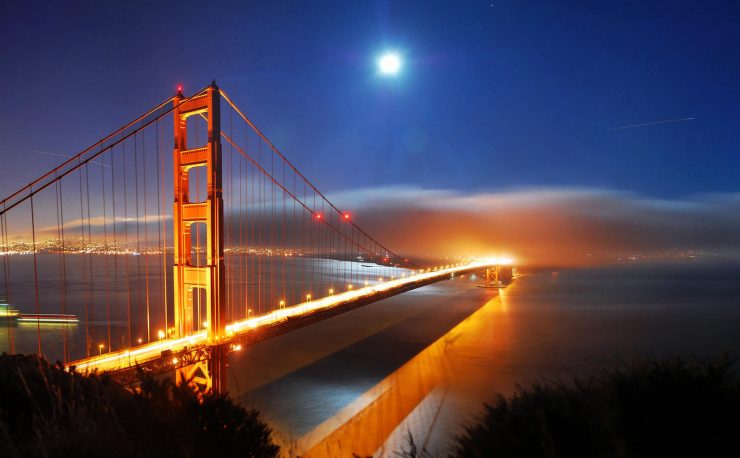
Prototypes of both the Brooklyn Bridge and the
Golden Gate Bridge can be found in Northern Kentucky. The
Robeling Suspension Bridge in Covington is the scale model of
the Brooklyn Bridge; while in nearby Maysville, the Simon
Kenton Memorial Bridge, the model of the Golden Gate Bridge,
was built across the Ohio River.
Famous
Kentuckians:Explorers, Pioneers & Frontiersmen, Political
Leaders, Military & Social Leaders, Scientists, Inventors & Physicians,
Artists & Architects, Authors & Journalists, Entertainers, Sports
Personalities...
ADDITIONAL READING
For additional information about Kentucky's history, refer to:
"Kentucky: A Bicentennial History" by Steven A. Channing;
"A History of Kentucky" by Thomas D. Clark; "History of Kentucky" by
Richard H. Collins;
"The Kentucky Encyclopedia" edited by John E. Kleber;
"Our Kentucky, A Study of the Bluegrass State" edited by James C.
Klotter;
"A New History of Kentucky" by Lowell H. Harrison and James C.
Klotter.
Click here to
go to the Kentucky Historical Society site.
Information and photos supplied by:
Kentucky Department of
Travel 500 Mero Street,
Suite 2200, Frankfort, Kentucky 40601
For more information, visit the
Kentucky Department of Tourism’s website at
www.kentuckytourism.com to see a list of Agri-tourism events
and festivals in the month of September. There are also several
links to organizations that make the promotion of agriculture
and Agri-tourism-awareness a goal in everything that they do.
For
information about accommodations, recreation, dining and much
more in this area and many other US destinations, take a moment
to visit our US Travel Directories: